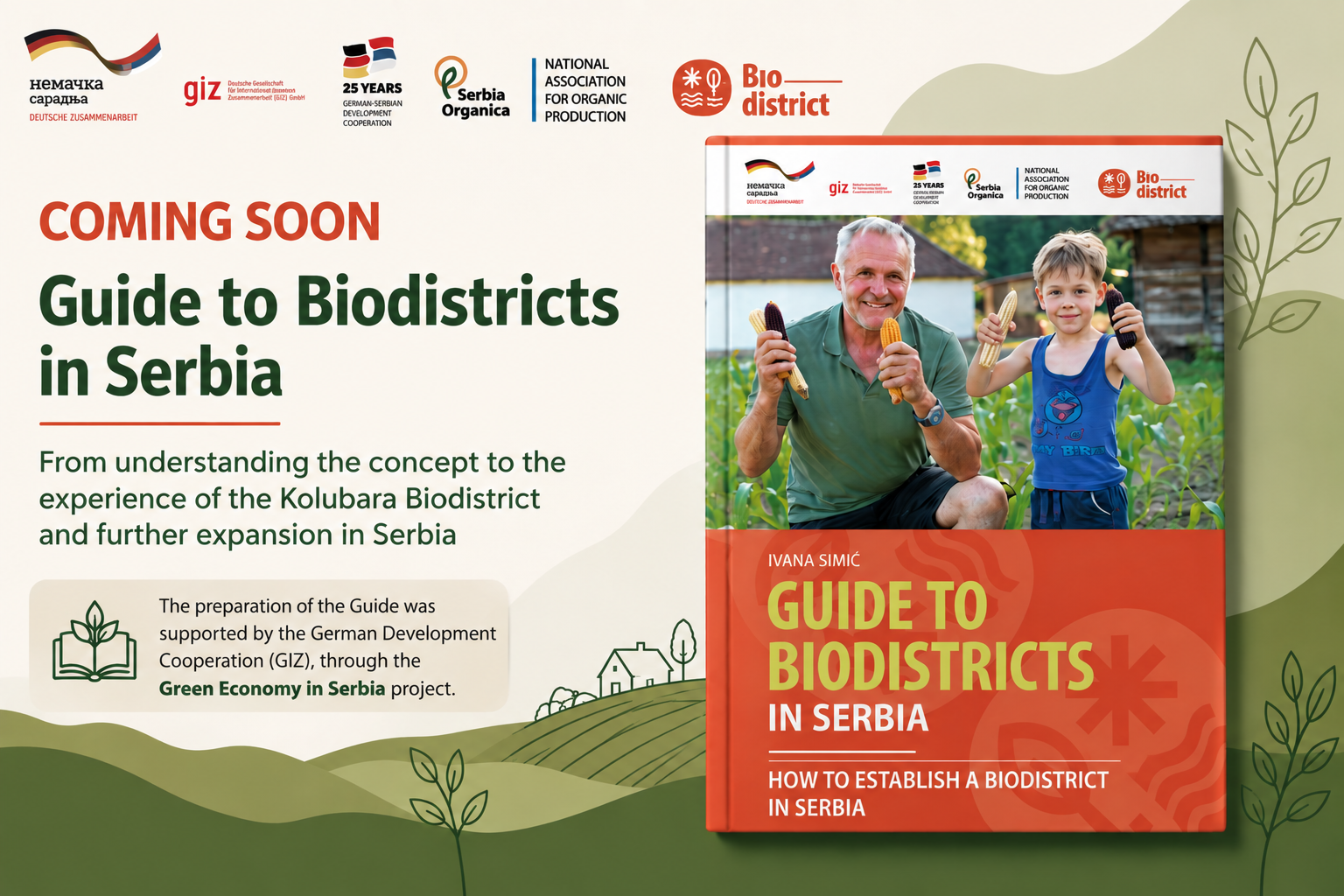
Coming Soon: Guide to Biodistricts in Serbia – From Understanding the Concept to the Experience of Kolubara Biodistrict and Further Expansion in Serbia
How does a biodistrict come into being? What does the concept entail, what principles does it build on, and how can it contribute to the sustainable development of a territory? And, most importantly, how can the biodistrict model be applied and further developed in Serbia?
The Guide to Biodistricts in Serbia seeks to answer these and other questions and will soon be published in both Serbian and English. The Guide draws on the experience of introducing the biodistrict concept in Serbia and the process of establishing the Kolubara Biodistrict, the first biodistrict in Serbia and in the Western Balkans. The preparation of the Guide was supported by the German Development Cooperation (GIZ), through the Green Economy in Serbia project.
The Guide is structured into two interconnected parts.
The first part focuses on the concept and model of biodistricts. It explains what a biodistrict is, how the concept emerged and developed in the European context, its main characteristics and principles, who the key actors are, and how they can be connected at the territorial level. Particular attention is given to different aspects of biodistrict functioning, from linking agriculture and nature conservation to developing the local economy, short value chains, social cooperation and community engagement.
The second part focuses on the potential for developing biodistricts in Serbia. Drawing on international experience and the experience of developing the Kolubara Biodistrict, this part explores how the concept can be adapted to Serbia’s institutional, economic, agricultural and social context. It presents possible organizational models, the roles of different local and national actors, as well as methodological approaches and practical steps relevant to initiating and developing biodistricts in other parts of Serbia.
A dedicated chapter focuses on the Kolubara Biodistrict as the first example of this model in Serbia. It presents the process of its establishment and development, experiences in connecting local producers, organizations, institutions and other actors, the activities and initiatives developed, as well as the challenges encountered and the ways in which they were addressed. This experience provides an important basis for understanding how the biodistrict concept can be translated from a theoretical and European framework into a concrete territorial context in Serbia.
The value of the Guide lies in the fact that it does not view a biodistrict merely as an organizational model, but as a process that is gradually built through connecting people, knowledge, natural resources and the local economy around a shared territorial vision. Organic farming is one of the important foundations of this approach, but the potential of biodistricts extends beyond organic production. The focus also includes agroecological approaches, biodiversity conservation, sustainable use of natural resources, development of local value chains, culture and social development.
The Guide was developed with the aim of making the experience gained through the development of the Kolubara Biodistrict available to other territories in Serbia that recognize the potential of using a similar approach to connect agriculture, nature conservation, the local economy and the development of rural communities.
The Guide is not intended as a definitive blueprint, but rather as a basis for understanding, initiating, adapting and further developing the biodistrict model in Serbia – through experience, cooperation and the specific needs of each individual territory.
The Guide will be published soon on the website, where it will be available to read and download.